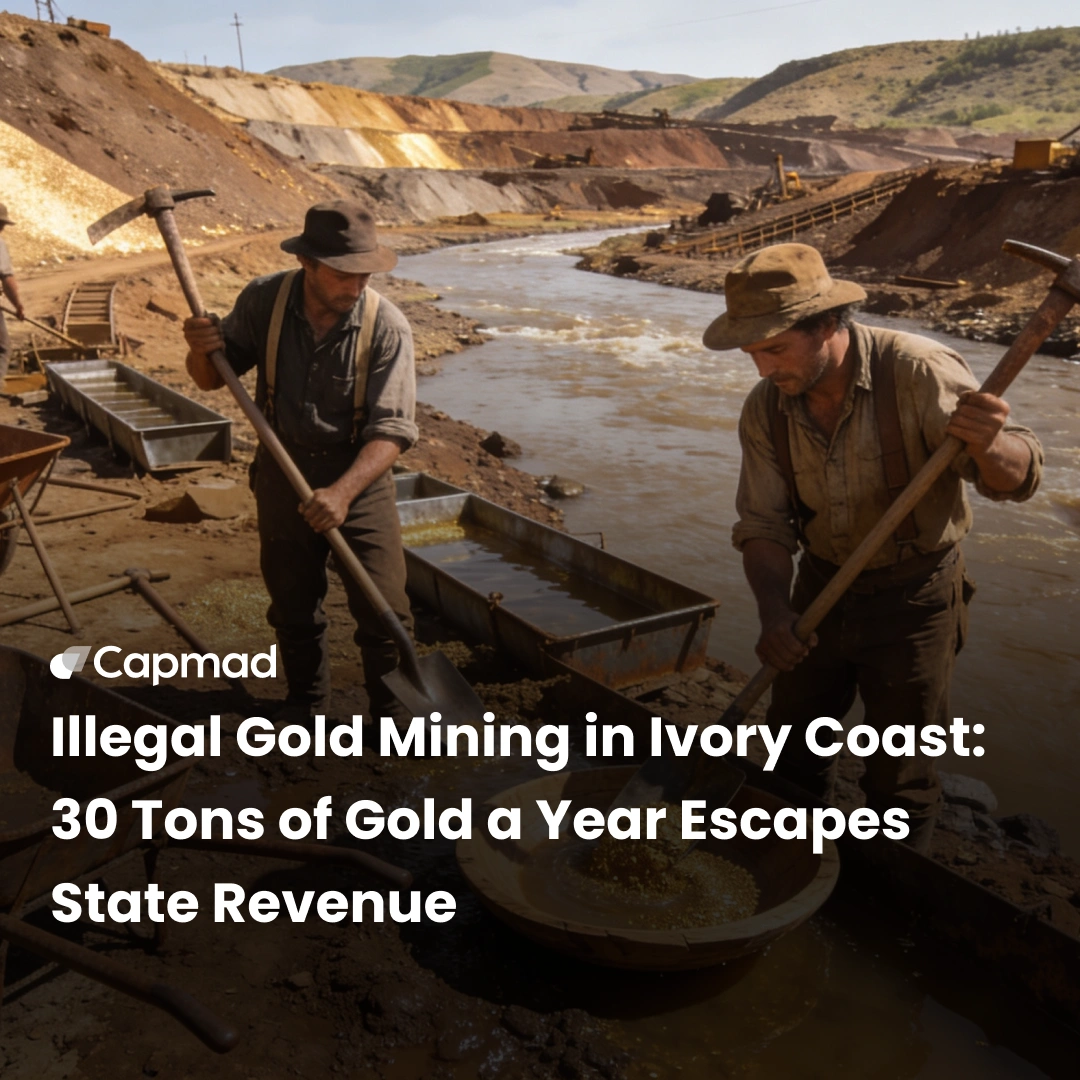
The Ivorian artisanal mining sector is entering a decisive phase. Gathered in Yamoussoukro for the second edition of the “Mine & Deal” workshop, stakeholders in artisanal and small-scale mining aim to transform this still fragmented activity into a genuine engine of inclusive and sustainable growth.
This development marks a turning point for Côte d’Ivoire, where artisanal gold already represents a significant portion of national production and where authorities are seeking to better structure a sector long dominated by informality.
A Sector in Search of Structure
The central challenge is to shift artisanal mining from a survival-oriented approach to a performance-driven one. The Group of Artisanal Miners of Côte d’Ivoire (GRAMCI) is pursuing this ambition with the support of the authorities and technical partners, in a context where professionalization appears to be the primary condition for moving upmarket.
The meeting in Yamoussoukro served as a reminder that the sector remains hampered by several obstacles: lack of structure, limited access to financing, insufficient geological data, and the persistence of illegal gold mining.
The Key Role of Geological Data
For SODEMI, one of the most important levers remains knowledge of the subsoil. Its Director General, Seydou Moussa Koné, emphasized the need for reliable geological data, particularly through mapping and geolocation, to better guide mining operations and reduce risks.
This approach addresses a dual objective. On the one hand, it provides greater security for small-scale operators’ investments; on the other, it helps the government to combat illegal mining operations more effectively, which weaken the sector.
Visible Results
The signals coming from the sector are encouraging. In 2025, Côte d’Ivoire recorded 977.2 kilograms of gold from the artisanal and semi-industrial sectors, including 263.3 kilograms from artisanal mining and 713.9 kilograms from semi-industrial mining.
The number of permits issued also confirms this trend: 279 permits were granted in 2025, bringing the total number of valid permits to 820. These figures show that small-scale mining is no longer just a marginal activity, but a sector undergoing formalization.
A lever for inclusive growth
Beyond the volumes produced, the strategic interest of the sector lies in its social potential. With proper regulation, artisanal mining can create jobs, structure local value chains, and strengthen the incomes of rural communities.
It is precisely within this framework that Côte d’Ivoire is aligning itself with a broader trend in West Africa: making artisanal gold mining a safer, more transparent activity, better integrated into the formal economy. The challenge is to transform a dispersed resource into sustainable wealth, without replicating the excesses of uncontrolled exploitation.
The remaining challenges
The small-scale mining revolution can only succeed under certain conditions. It will be necessary to strengthen the training of artisanal miners, improve access to financing, expedite the issuance of mining permits, and create a tax framework adapted to the realities of small operators.
The fight against illegal gold panning also remains crucial. Without traceability, oversight, and technical support, the sector risks remaining vulnerable to informal networks and value loss.
A transformation to watch closely
With “Mine & Deal,” Côte d’Ivoire appears to be laying the foundations for a new model for small-scale mining. The country is seeking to reconcile formalization, security, transparency, and local development, while giving the artisanal sector a more visible place in the national economy.
If this momentum continues, small-scale mining could become one of the country’s next growth drivers, alongside other, more established extractive sectors.
✍️ Want to contribute a high-value article?
Contact us for a guest post : [email protected]
Write to the editorial team