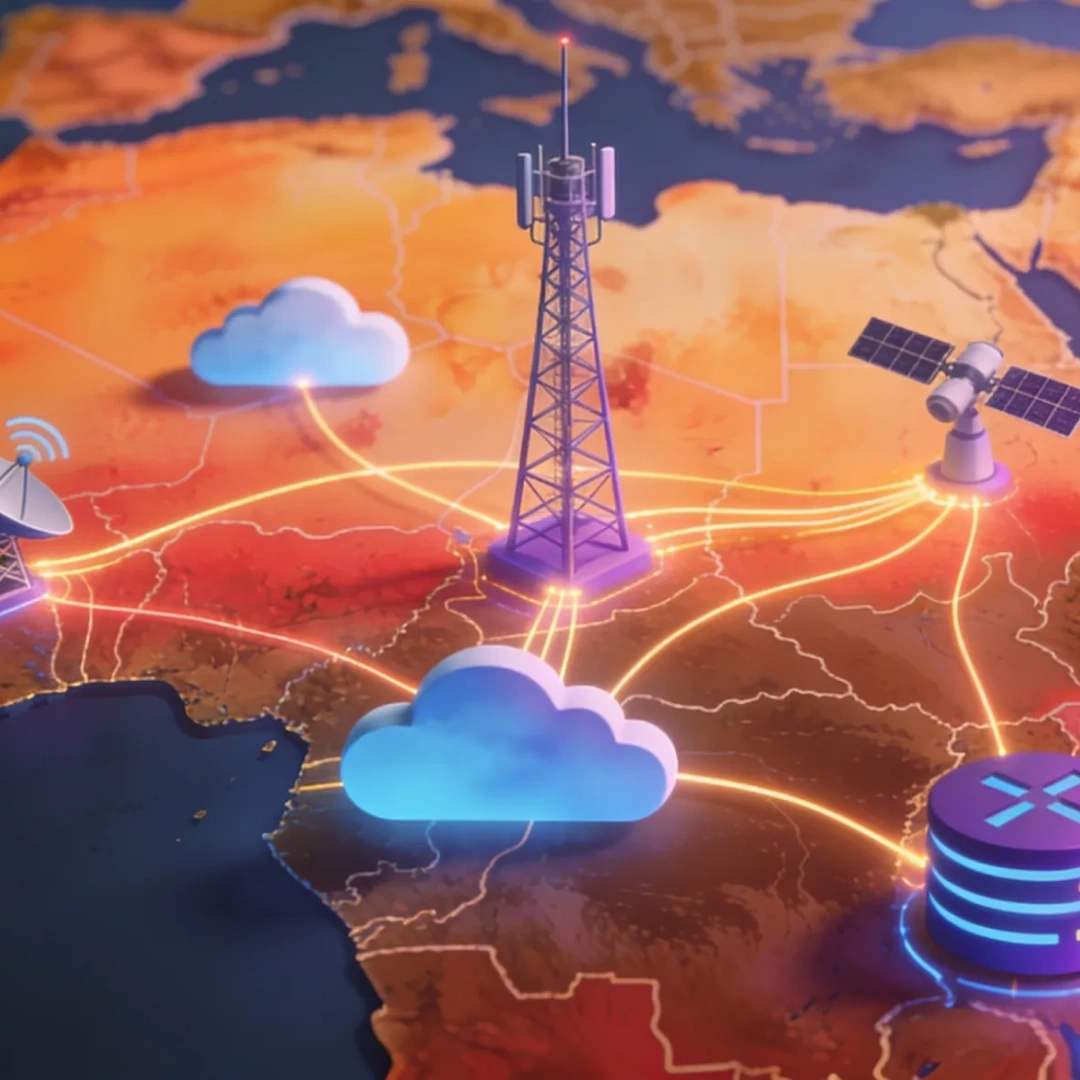
The Via Africa submarine cable project, initiated on 12 May 2026 through a memorandum of understanding between Orange and several international investors, marks the launch of a planning phase. This strategic infrastructure aims to connect Europe and Africa.According to Orange Wholesale, this future system will strengthen redundancy all along the Atlantic seaboard in addition to the 2Africa cable, commissioned at the end of 2025 and connecting more than 30 African countries.
The layers of this connectivity – submarine cables, fibre backbones, 4G and then 5G networks – remain tightly interlinked, and the DataCup authors note that each major subsea cable outage, such as in West Africa in March 2024, reveals the continent’s dependence on a handful of critical routes.
“Submarine cables are the silent foundation of African connectivity: without them, neither 4G, nor 5G, nor cloud services hold together.” — A technical manager at a West African operator, DataCup
Subsea cables: rising capacity, persistent vulnerability
The latest large systems – 2Africa led by Meta and partners, and Google’s Equiano cable – have ushered Africa into a new era of international capacity, with 2Africa’s announced design capacity of up to 180 terabits per second, exceeding the combined capacity of earlier systems serving the continent. The same 2Africa system, deployed in segments since 2023, was declared complete and activated at the end of 2025, after progressive go-lives on the west and east coasts and landings in countries such as the Democratic Republic of Congo, Angola and South Africa.
The new Via Africa project positions itself in this landscape as an additional cable between Europe and Africa along the Atlantic corridor, with participating operators highlighting the need for route diversity and redundancy after repeated incidents in the Red Sea and the Atlantic. Downstream, operators in countries such as Angola have already inaugurated their 2Africa landing stations, officially opened in 2025, to capture this new international capacity and feed it into their terrestrial backbones.
Recent delays on 2Africa’s Pearls segment, following a deteriorating security situation in the Red Sea and the Gulf where cable layer Alcatel Submarine Networks declared force majeure, nonetheless underline the geopolitical dimension of these infrastructures.
Fibre backbones: stitching together inland territories
Inside the continent, the priority remains to roll out fibre backbones linking capitals, secondary cities and borders, as shown by the Trans-Sahara Optical Fibre Backbone Project in Niger, where over 1,000 kilometres of fibre were provisionally accepted in late 2025 with support from the African Development Bank. Similar schemes underpin the Central Africa Backbone, whose Cameroon component, backed by the African Development Bank, aims to build a regional backbone interconnecting ECCAS countries via high-speed links.
In April 2026, the African Development Bank approved 200 million dollars in financing for Nigeria’s Digital Value Chain Infrastructure Project, designed to extend the country’s fibre backbone and close connectivity gaps in West Africa’s largest market. Project documents for the Central African Republic component of the Central Africa Backbone stress that a continuous national backbone is a prerequisite for modernising public services and attracting private digital investment.
4G and 5G: densifying last-mile access
Mobile 4G networks remain today the main vector of mass-market high-speed access in Africa, and DataCup’s authors emphasise that these networks sit on top of fibre and microwave links connecting base stations, core networks and cable landing points. In more advanced markets such as South Africa, the rapid extension of fibre-to-the-home by players such as Vumatel – whose parent company Maziv secured a 25 billion rand loan in 2025 from a bank consortium to continue roll-outs – is gradually changing the balance between fixed and mobile.
At the same time, the rise of data centres and AI use cases is generating stronger demand for low-latency, stable capacity, pushing operators to invest in enterprise 5G and urban backbones to support industrial and cloud applications. The DataCup article underlines the architectural challenge: without effective interconnection between submarine cables, national backbones and mobile networks, 5G’s promises remain theoretical for most African users.
Watch points for investors
- Concentration of international routes: despite the arrival of new cables, dependence on a few corridors such as the Red Sea or the Gulf of Guinea creates systemic risk.
- Continuity of terrestrial backbones: missing links between capitals and borders slow down the monetisation of subsea capacity.
- Competitive framework: the balance between sharing passive infrastructure and competing on services remains key to avoiding positional rents.
- Power and resilience: dense 4G/5G networks and data centres require stable electricity supply that often exceeds the current capabilities of national grids.
Against this backdrop, the full activation of 2Africa and the materialisation of projects like Via Africa by the end of the decade are critical milestones for both investors and national regulators, who will have to calibrate licences, sharing obligations and policies to support inland backbones.
✍️ Want to contribute a high-value article?
Contact us for a guest post : [email protected]
Write to the editorial team