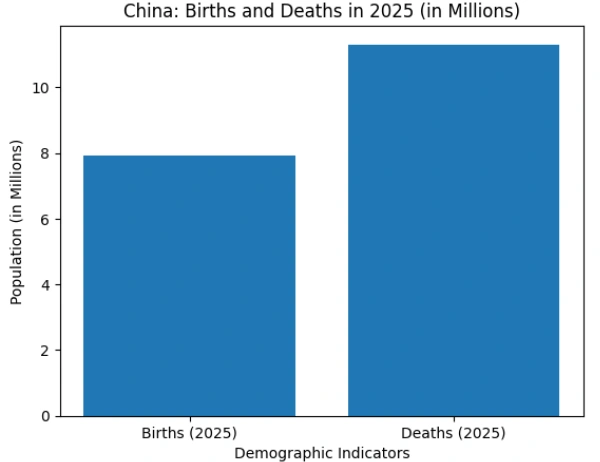
China is facing an unprecedented demographic crisis: for the fourth consecutive year in 2025, its population declined, falling to 1.404 billion, with a historically low birth rate of 5.63 per 1,000 inhabitants and only 7.92 million births. This accelerated aging, combined with a plummeting fertility rate of around 0.8 children per woman, is putting a heavy burden on future consumption and threatening the stability of pension systems.
A Population in Structural Decline
Despite the end of the one-child policy in 2015, followed by the authorization of three children in 2021, births are not recovering: 2025 marks the absolute lowest point since 1949, with 11.31 million deaths compared to 7.92 million births. This imbalance, exacerbated by aging (nearly 310 million people aged 60 or older by 2024), is making China the scene of a demographic revolution that could halve its population by 2100, according to UN projections (633 million inhabitants).
The root causes include the high cost of raising children (education, housing), the housing crisis, urban stress, and a work culture incompatible with parenthood, despite incentives such as subsidies of 3,600 yuan per child up to age 3 and tax exemptions for daycare centers.
Pressure on domestic consumption
An aging and shrinking population radically alters economic dynamics: demand for everyday consumer goods (clothing, appliances, automobiles) is likely to stagnate, while the needs for healthcare, long-term care, and products for seniors are skyrocketing. With fewer young consumers, giants like Alibaba and Chinese automakers could see their domestic growth hampered, forcing them to rely more heavily on exports—a challenge in a protectionist world.
This “peak consumption,” anticipated as early as the 2020s, is now being confirmed: the decline in marriages (down 20% by 2024) and births is reducing family spending, impacting the housing, education, and leisure sectors, pillars of the post-pandemic Chinese economy.
Pension Systems Under Maximum Strain
The dependency ratio is skyrocketing:
- In 2025, there will be approximately 5 workers for every 1 retiree, compared to 10 to 1 twenty years ago.
- By 2035, it will be 2 to 1.
The public pension system, already running a deficit in many provinces, risks bankruptcy without drastic reforms: raising the retirement age (currently 60 for men, 50-55 for women), increasing contributions, or cutting pensions.
The authorities are testing emergency measures – taxing contraceptives, simplifying marriage, and providing family allowances – but experts doubt their effectiveness in the face of structural factors such as urbanization and regional inequalities.
Major Economic and Geopolitical Stakes
This “demographic time bomb” is jeopardizing Chinese growth: a shrinking workforce is hindering productivity, while social costs are skyrocketing (healthcare, pensions). Beijing is banking on automation, artificial intelligence, and selective immigration, but nothing can compensate for such a rapid decline.
Internationally, China is losing its position as the world’s most populous power (overtaken by India in 2023) and is seeing its soft power diminish with a shrinking youth diaspora. For Xi Jinping, reversing this trend is becoming a matter of economic survival: without a birth rate rebound, the Chinese miracle could run out of steam permanently, reshaping the global balance of power.