In 2026, Algeria presents itself as an economy on the move. With the third-largest GDP on the African continent and the region’s leading producer of natural gas, the country harbors ambitions commensurate with its potential: to become the continent’s leading economy by 2030. Yet, behind the encouraging figures, deep-seated structural vulnerabilities persist, raising questions about the robustness of this transformation project. An overview of an economy at a crossroads.
A solid macroeconomic foundation… on the surface
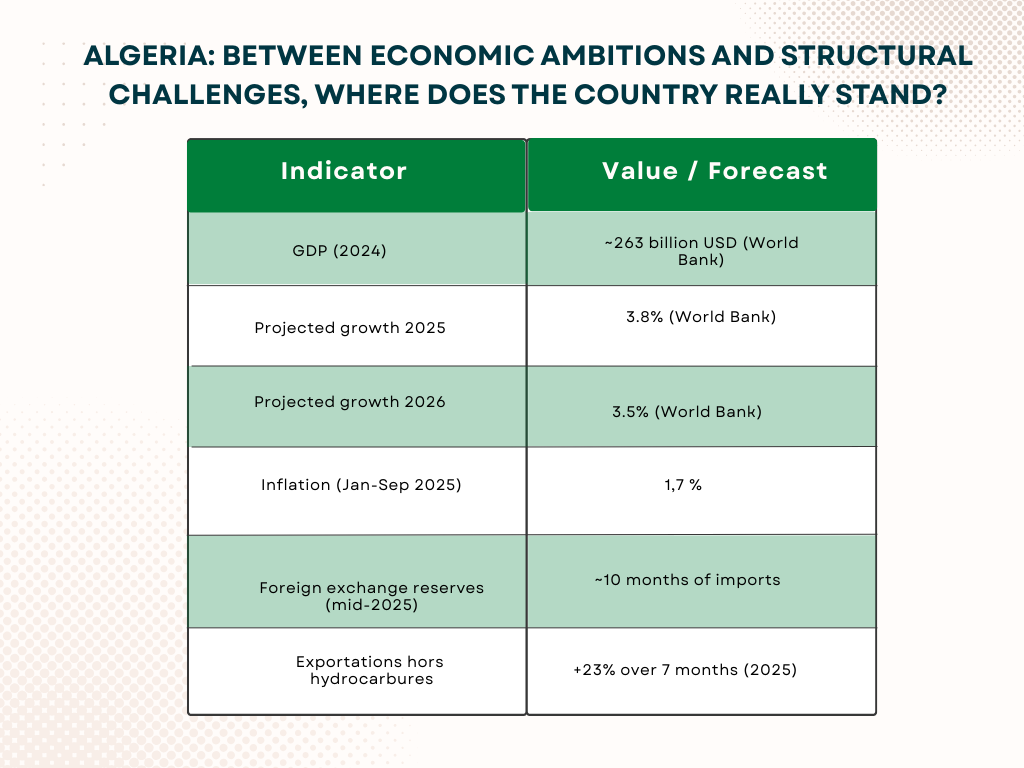
The aggregate indicators paint a rather favorable picture. Algeria’s GDP reached approximately $263 billion in 2024, according to World Bank data, and is projected to exceed $285 billion in 2026, according to IMF projections. Growth, driven primarily by household consumption and public investment, is estimated to be between 3.5% and 3.8% for 2025-2026, depending on the source.
In the first half of 2025, non-hydrocarbon sectors saw a 5.4% increase, fueled by industry (+6.4%), trade (+6.7%), and agriculture (+4.5%). Inflation was kept under control at 1.7% for the first nine months of the year—a remarkable result, well below the levels observed in many comparable countries.
Hydrocarbon Dependence: The Gordian Knot
While Algeria is progressing, it is still doing so massively on the crutches of oil and gas. Hydrocarbons represent 84% of exports, 48% of public revenue, and 13% of GDP. Such a high concentration on a non-renewable resource, subject to the vagaries of global markets, constitutes the primary vulnerability of the Algerian model.
The drop in crude oil prices directly impacts public finances. The budget equilibrium price is estimated at around USD 142 per barrel—while the average price expected in 2026 is around USD 60. The gap is enormous. This situation forces the state to draw on its reserves or to reduce spending, at the risk of slowing investments in promising sectors.
Key Figure
The price per barrel needed to balance the Algerian budget is estimated at USD 142, more than double the market price expected in 2026 (~USD 60). A major budgetary constraint.
Furthermore, the reduction in OPEC+ quotas forces Algeria to limit its production, mechanically reducing its financial flexibility. Added to this is the depletion of the Revenue Regulation Fund (FRR), which served as a budgetary safety net.
Diversification: a promising but unfinished project
Agriculture and the agri-food industry
Agriculture is the second largest contributor to GDP (between 13 and 15% according to various sources), but remains below its potential. The sector suffers from low productivity, a lack of logistical infrastructure, and dependence on imports of basic food products. However, positive signs are emerging: agricultural production is projected to reach nearly $34 billion in 2025, and the government has set ambitious self-sufficiency targets.
Pharmaceutical Industry: A Model Sector
The pharmaceutical industry illustrates the potential of diversification: with 218 active factories in 2025, Algeria now covers more than 70% of its drug needs through local production and accounts for 30% of all pharmaceutical production in Africa. This import substitution model deserves to be replicated in other sectors.
Non-Hydrocarbon Exports: The Great Unknown
Fertilizers, cement, chemicals, pharmaceuticals: “Made in Algeria” products are now exported to more than 120 countries. Non-hydrocarbon exports jumped 23% in the first seven months of 2025. The government aims for $10 to $15 billion in non-hydrocarbon exports by 2026—an ambitious target, the achievement of which remains to be confirmed on an annual basis.
Major Infrastructure Projects
The Algerian state is investing heavily in infrastructure to support long-term growth. Among the flagship projects are:
Algiers–Tamanrasset Railway: In December 2025, the African Development Bank granted a €747 million loan to finance the first phase of this massive project. The goal is to double the national rail network—from 5,000 to 10,000 km—by 2030.
Renewable Energy: The “Solar 1000 MW” project and the tax incentives in the 2026 Finance Law for photovoltaic components are paving the way for a national solar energy sector. This is a strategic move to reduce domestic gas consumption and free up more for export.
Record Public Spending: Algeria plans to spend approximately $135 billion on public energy in 2026, the highest level in its history. An undeniable driver of growth, but one that is widening a budget deficit estimated at 21.8% of GDP in 2025.
Persistent obstacles to transformation
The ambition is real. But several structural obstacles are slowing economic transformation:
A difficult business climate: room for maneuver and access to credit remain limited for private companies. The World Bank regularly emphasizes the need to improve governance, tax transparency, and the conditions for attracting foreign investment.
A massive informal sector: at the end of 2019, approximately 5 trillion dinars were circulating outside official channels (30% of the money supply). Despite progress—Algeria was placed on the FATF grey list in October 2024 and is working to address this—formalizing the economy remains a significant challenge.
Employment and Youth: Algeria is experiencing sustained population growth (+700,000 inhabitants per year, reaching 46.7 million in 2024). Absorbing this influx of young people into the labor market requires the creation of private sector jobs, which public investment alone cannot guarantee.
Import Dependence: Despite diversification efforts, the country remains heavily dependent on imports for food products, intermediate goods, and industrial equipment. The increase in imports in 2025 has also put pressure on the current account balance.
Conclusion: Between Real Potential and Enduring Vulnerabilities
Algeria is not a country in crisis. It is a country under tension—between declining oil revenues and an incomplete economic transformation, between legitimate regional ambitions and structural reforms that are slow to produce their full effects.
The country possesses undeniable strengths: comfortable foreign exchange reserves, relatively controlled public debt, a booming pharmaceutical industry, rising non-hydrocarbon exports, and massive public investment in infrastructure. However, these gains remain fragile as long as the economy has not truly loosened its grip on hydrocarbons.
The key question for 2026 is this: will Algeria manage to translate its ambitions into tangible results before budgetary constraints become too burdensome?
The answer will depend, to a large extent, on the speed at which reforms to the business climate and genuine economic diversification take shape.