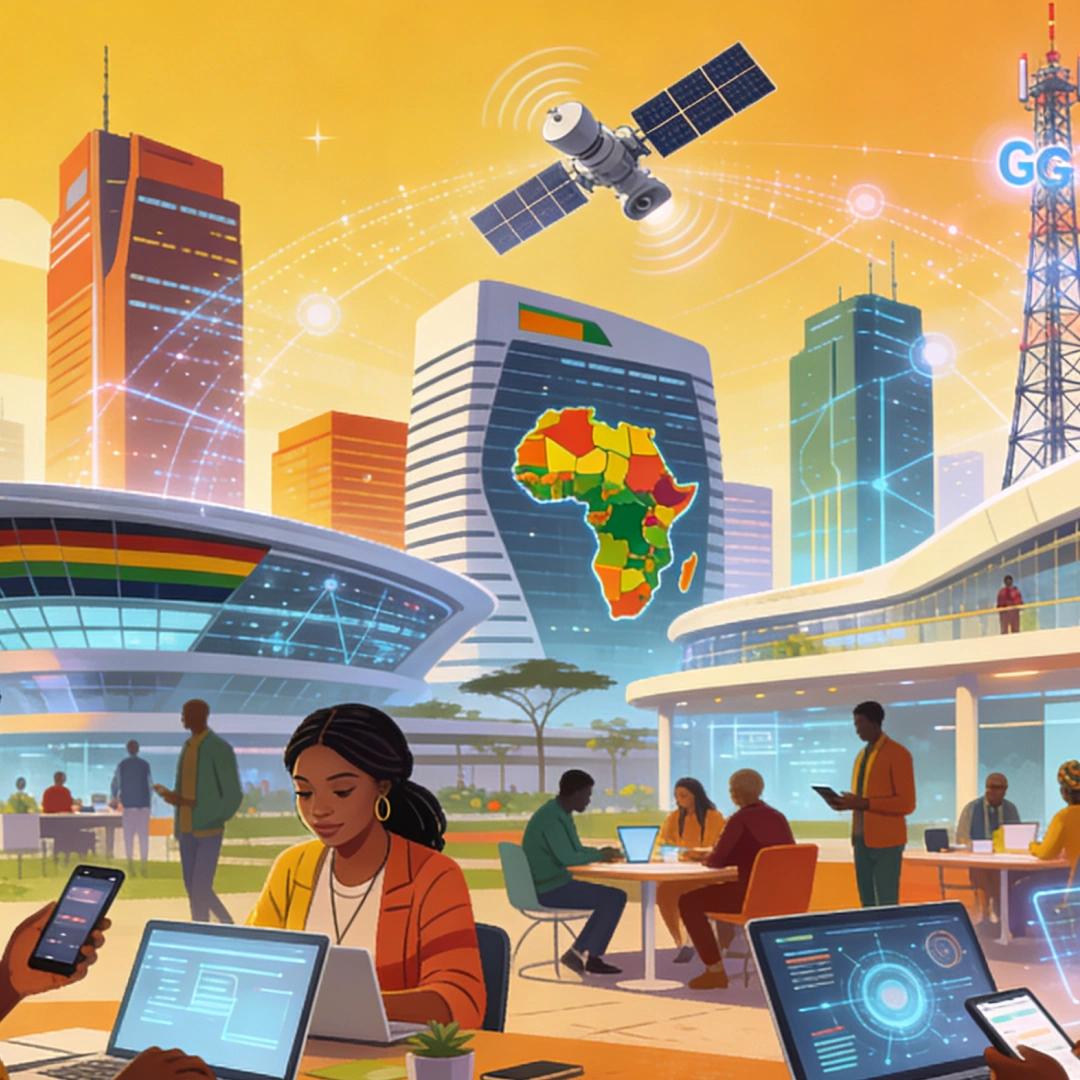
The arrival of Starlink in Senegal marks a new stage for broadband connectivity, promising to bridge the digital divide between Dakar and rural areas… provided its integration, regulation, and accessibility are successful.
Starlink Launches in the Senegalese Market
SpaceX’s satellite internet service is now operational throughout Senegal, with consumer packages priced between 22,000 and 30,000 CFA francs per month, excluding the cost of the connection kit.
Two types of equipment are available, priced between approximately 117,000 and 146,000 CFA francs, with advertised speeds of up to 305 Mbps download and 40 Mbps upload, making it competitive with many urban fixed-line internet offers.
This arrival comes at a time when the country has made connectivity a major focus of its digital strategy, with the stated objective of providing broadband internet coverage across the entire territory through a technological mix (fiber, mobile, satellite).
A possible solution to the digital divide
Access inequalities are significant: approximately 44% of households in Dakar have an internet connection, compared to barely 3% in rural areas, according to studies by ARTP and ANSD.
A survey presented in 2025 still showed that 24% of localities had no network coverage, while more than a third only had an unstable signal or 2G poorly suited to modern uses.
Thanks to its constellation of low-Earth orbit satellites, Starlink promises near-national coverage, including in isolated villages, for priority uses such as e-education, telemedicine, online public services, rural e-commerce, and financial inclusion.
An asset… but not a miracle solution
While Starlink offers a new technological option, several challenges immediately arise:
- High entry cost: the price of the kit and the subscription remain out of reach for a large portion of rural households and small businesses, despite its competitive pricing for a satellite service.
- Regulatory framework: the arrival of a global player raises questions of digital sovereignty, data control, taxation, and coordination with the national regulator.
- Complementarity with local operators: Sonatel/Orange and other players are already testing satellite and fixed-line solutions, hence the need to avoid unbalanced competition that would weaken the national ecosystem.
The authorities are also emphasizing that satellite internet, and Starlink in particular, should complement – not replace – existing terrestrial networks, especially fiber optics and 4G/5G.
The State’s Key Role in Digital Inclusion
The Senegalese government has announced a program to connect one million citizens to the internet via satellite antennas and solutions, prioritizing schools, health centers, border areas, and isolated administrative buildings.
Within this framework, Starlink kits could be deployed in public spaces (schools, digital centers, community hubs) to share the connection and reduce the cost per user.
The State has a twofold objective:
- to guarantee equitable access, preventing satellite broadband from becoming a service reserved for wealthy urban dwellers, NGOs, or large corporations;
- To provide a technical and legal framework for the service (quality, cybersecurity, data protection, taxation) to ensure its coherent integration into the national digital transformation strategy.
Towards a new balance in Senegal’s digital landscape
Starlink is neither a magic bullet nor an automatic threat: it is a new tool in an already evolving ecosystem.
If properly regulated, interconnected, and targeted at underserved areas, it can accelerate the achievement of universal connectivity goals and stimulate Senegal’s digital economy, from startups to public services.
However, if access remains limited to those who can afford it and if regulation fails to keep pace, the risk is that a new divide will emerge: between those who can afford Starlink and fully benefit from digital technology, and those who remain on the margins of the network.
The challenge in the coming months will therefore be crucial: to transform the arrival of Starlink into a lever for digital inclusion, rather than a symbol of increased inequality in Senegal’s digital space.
✍️ Want to contribute a high-value article?
Contact us for a guest post : [email protected]
Write to the editorial team