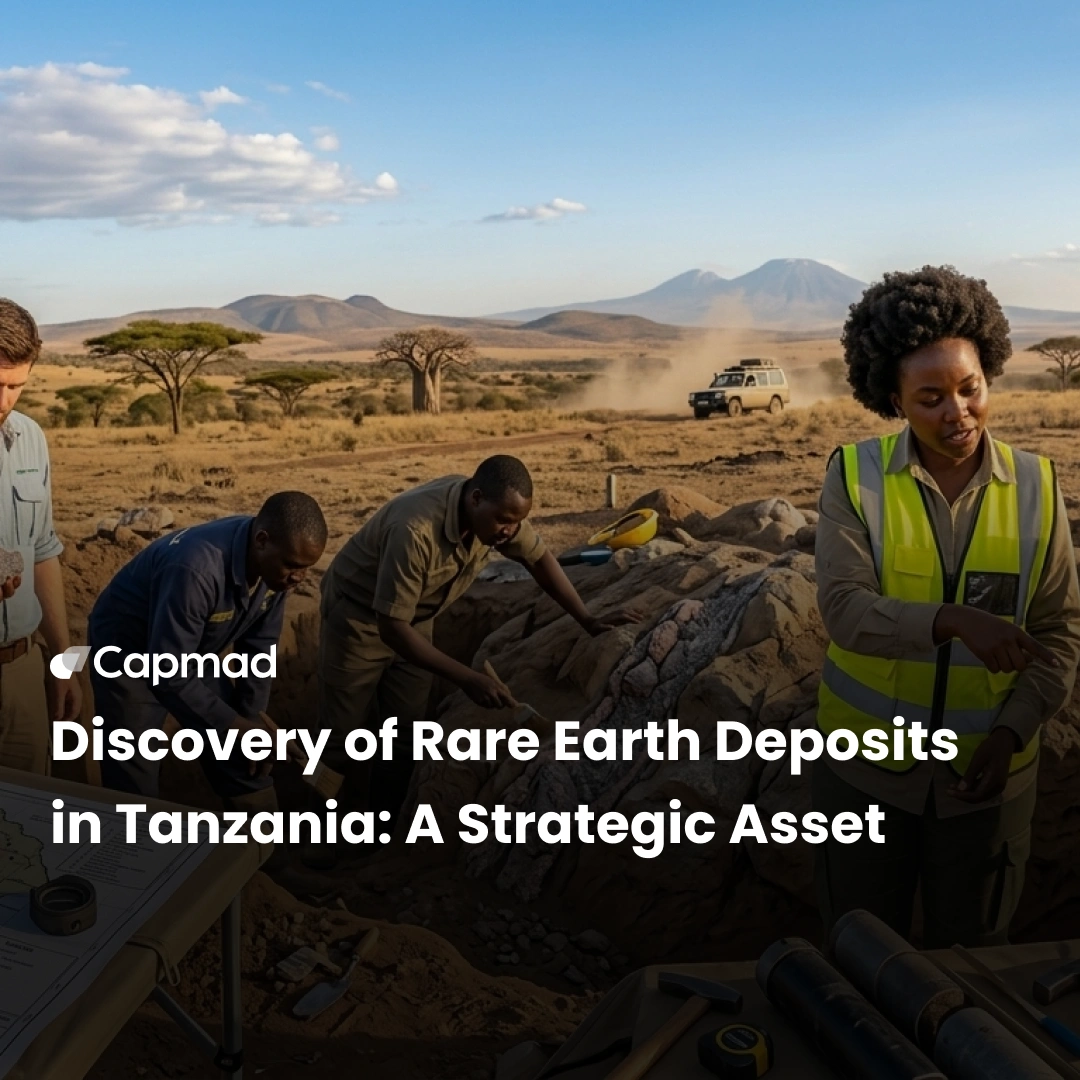
Tanzania has decided to scale up its mining strategy: the government aims to expand exploration to 50% of its territory by 2030, compared to approximately 16% today. The objective is to better map its subsoil, attract investors, and maximize economic benefits for the country.
This ambitious goal is part of the “Mining Vision 2030.”
The Minister of Mines, Anthony Mavunde, indicated that President Samia Suluhu Hassan has instructed that exploration coverage (particularly through high-resolution aerial surveys) be extended to half of the national territory by 2030.
To date, only 16% of Tanzanian territory has been the subject of detailed mineral exploration, leaving considerable undocumented potential, especially for critical minerals (nickel, cobalt, copper, manganese) essential for the global energy transition.
This trajectory is part of the “Tanzania Mining Vision 2030,” which aims to reduce risk for investors in the sector by producing reliable geological data, while simultaneously strengthening the state’s sovereignty over its resources.
A strategic partnership with South Korea
To realize this ambition, Tanzania has entered into an agreement with the Korea Institute of Geosciences and Mineral Resources (KIGAM).
A Memorandum of Understanding (MoU) now links the Geological Survey of Tanzania (GST) to KIGAM for:
- the establishment of a mining technology center equipped with modern tools for prospecting and analysis;
- the development of a digital mineral resource information system (shared geological data platform);
- the capacity building of Tanzanian experts in deposit exploration and modeling; and
- the integration of ESG (environmental, social, and governance) standards into mining projects.
The project is estimated at approximately USD 16.5 million, with Korean funding exceeding 21.8 billion won.
A mining sector already booming
- This surge in exploration comes as the mining sector has already surpassed agriculture as the country’s leading source of foreign exchange.
- The sector’s contribution to GDP has increased from approximately 3.5% to nearly 4.8%, with a target of at least 10% in the short to medium term, according to the Ministry of Mines.
- The mines have created more than 19,000 direct jobs, nearly 97% of which are held by Tanzanians, in accordance with the local content policy.
- Tanzanian companies have sold approximately USD 1.48 billion worth of goods and services to mining projects, demonstrating the positive impact on the local private sector.
Gold remains the driving force: it represents more than 55% of the country’s total exports in 2025, with estimated revenues between $4.4 and $4.7 billion, while official reserves exceed $1.3 billion.
Promoting investment and capturing the value of critical minerals
By increasing geological surveys and covering 50% of the territory, Tanzania aims to:
- reduce risk for mining companies, which will no longer have to invest in “blind” areas;
- better target areas rich in critical minerals (nickel, cobalt, copper, manganese, rare earth elements) to meet the demand for batteries, electric vehicles, and renewable energy;
- strengthen local processing capacities (smelting, refining), as exemplified by the Kabanga Nickel multi-metal smelter project, which is also expected to serve neighboring countries (Burundi, DRC).
The challenge is to shift from a raw ore export model to an integrated value chain, where Tanzania captures more added value within its own borders.
Environmental and Social Challenges
However, expanding exploration to half the country raises sustainability concerns:
- risks of increased pressure on agricultural land, forest areas, and community territories;
- the need to effectively implement the ESG standards outlined in the agreement with KIGAM to mitigate social and environmental impacts;
- the importance of involving local communities in decision-making, especially in areas where artisanal mining and agriculture coexist.
The government claims to want to reconcile mining growth with responsibility, positioning Tanzania as a future African hub for strategic minerals, but this ambition will be judged by transparency, revenue redistribution, and environmental protection.
✍️ Want to contribute a high-value article?
Contact us for a guest post : [email protected]
Write to the editorial team